Big Tech, Big Targets: AI and Data Centers in the 2026 Senate Race

Data Center buildouts and AI are getting attention this midterm election season. The public’s views on data centers and AI have dimmed, with Pew Research reporting a sizeable negative shift in public attitudes since the start of the year.
The public’s souring mood raises questions about the campaigns. Are political candidates using data centers and AI as a topic to boost their standing with the electorate or possibly to knock down their opponent?
To get a sense of where things stand (and with help from my research team), I collected social media posts, Facebook and Twitter (now X), from the candidates running for US Senate to better understand how focused the campaigns are on AI and datacenters. The data analysis that follows is only from September, so it’s a snapshot before general election races really heat up in October through Election Day.
Overall, what we find is a mixed picture. Democrats are more likely than Republicans to post about data centers and AI. Candidates in states with a high density of data centers are more likely to post. In highly competitive races, the candidates attack their opponents or the presidential administration for being friendly to Big Tech and for failing to address high energy prices and AI safety, among other things.
For readers who want to know more about the methods that drove this analysis, see the Research Notes at the end.
What Drives Campaign Messaging about AI and Data Centers?
Only in three of the seven key Senate toss-up races did the candidates post about AI and datacenters (see Table 1). In Ohio, only the Democratic candidate posted on the topic, whereas both candidates posted about data centers and AI in Texas and Michigan. Competitiveness alone does not seem to drive messaging on data centers.
Table 1: Number of Data Center Social Media Posts in Toss-Up Races
|
Candidate |
State |
Party |
Data Center Posts (FB+TW) |
|
Daniel Sullivan |
AK |
R |
0 |
|
Mary Peltola |
AK |
D |
0 |
|
Ashley Hinson |
IA |
R |
0 |
|
Josh Turek |
IA |
D |
0 |
|
Susan Collins |
ME |
R |
0 |
|
Troy Dale Jackson |
ME |
D |
0 |
|
Mike Rogers |
MI |
R |
1 |
|
Abdul El-Sayed |
MI |
D |
13 |
|
John Sununu |
NH |
R |
0 |
|
Chris Pappas |
NH |
D |
0 |
|
Jon Husted |
OH |
R |
0 |
|
Sherrod Brown |
OH |
D |
22 |
|
Ken Paxton |
TX |
R |
6 |
|
James Talarico |
TX |
D |
2 |
One reason for that may be because although the race is competitive, data centers are not a hot-button issue for the electorate. Turning to Senate races where there is the most data center build-outs, include Virginia and Texas, we see that candidates are more likely to post about the topic (see Table 2).
Table 2: Candidate Posts on Data Centers (DC) in States with the Most
|
Candidate |
State |
Party |
DC Posts |
State DC Count |
National Rank |
|
Bert Mizusawa |
VA |
R |
4 |
674 |
1 of 51 |
|
Mark Warner |
VA |
D |
11 |
674 |
1
of 51 |
|
David Brock Smith |
OR |
R |
4 |
135 |
10 of 51 |
|
James Talarico |
TX |
D |
2 |
537 |
2
of 51 |
|
Ken Paxton |
TX |
R |
6 |
537 |
2 of 51 |
|
Jon Ossoff |
GA |
D |
2 |
276 |
4
of 51 |
|
Sherrod Brown |
OH |
D |
22 |
240 |
6 of 51 |
Doing a deeper statistical dive into the data, what I find first is that political party matters. Analyzing all of the candidates for Senate, I find that Democratic candidates are significantly more likely to post at least once about AI and data centers than their Republican opponents, regardless of race competitiveness. When I look at the frequency of posts, Democratic candidates and candidates in states with greater data center density (current and proposed) are likely to post more about AI and data centers.
In sum, party and data center density in a state drive when candidates talk about data centers and AI in their social media posts.
What Are the Candidates Saying about AI and Data Centers?
Overall, candidates who posted on the topic posted about the following: high electricity costs; water and land usages from data centers; concerns about tax breaks or subsidies to the AI companies for building data centers; AI safety and concerns about regulation; and issues around local community control around data centers. Some also attacked the Trump administration around the lack of regulation around AI and AI safety. In a few races, candidates highlighted issues of AI deepfakes.
Looking at a highly competitive races, the posts themselves say a great deal about the tensions and dynamics around data centers and the dynamics in those races.
I start with Virginia, the state with the largest concentration of data centers in the United States. There, the topic has grown increasingly contentious, and I wrote about Virginia as a test case in an earlier post. Republican challenger Bert Mizusawa’s posts have both praised the Trump administrations announcement to call AI Super Intelligence while at the same time attacking incumbent Mark Warner for being a proponent of data centers, such as this Tweet: “@MarkWarner LOVED data centers and wanted to bring them ‘across Virginia.’ Now he wants you to think he can stop the problems he started...” Warner, for his part, highlighted in several posts his efforts to launch an AI safety framework in congress, noting in a Tweet: “We need to make sure that AI is safe, fair and built for everyone.” None of his social media posts mention data centers.
In Texas, Democrat James Talarico’s two posts on AI attacked Republican Ken Paxton for using AI deepfakes to attack Talarico. On Facebook, he posted: “They don’t have any real attacks, so they’re firing up their data centers and making up fake ones.” Paxton’s posts directly address data centers, including Tweets highlighting that as the state’s Attorney General he has launched an investigation into data center projects to ensure compliance for water use. He also Tweeted that he is investigating a controversial data center proposal on land donated for use as parkland that town officials had turned over to a data center developer.
In the states with only one candidate posting, candidates are using the topic to either attack their opponents directly or indirectly. Oregon’s Republican challenger Brock Smith attacked Oregon’s Democratic governor, Tina Kotek, over a gas tax increase arguing that data centers are not driving up electricity costs but instead Democratic policies. In Ohio, Democratic challenger Sherrod Brown has been heavily on the attack against incumbent Republican Jon Husted on the topic. His posts have a populist appeal: attacking Husted for being a “data center guy” who has rigged the system for data centers and “Big Tech” against ordinary people and communities. In one Facebook post, he wrote: “Jon Husted gave out billions of dollars in sweetheart tax cuts to bring data centers to Ohio. Ohioans won’t stand for it.” Meanwhile, in Georgia, Democratic incumbent Jon Ossoff attacked President Donald Trump for not ensuring safe AI.
One candidate stands out in the dataset for his heavy focus on data centers as part of campaign strategy. Nearly half of South Dakota independent challenger Brian Bengs’ posts are on the topic. Even though South Dakota is one of the lowest data center density states, Bengs has used the topic to attack incumbent Republican Mike Rounds for being in the back-pocket of Big Tech. In one Facebook post, he highlights a Politico investigation revealing that one of Rounds’ senior aides is a registered Meta lobbyist. In another post he writes: “META has pumped over half a million dollars into statehouse races to advance pro-data center candidates. How can we expect them to respect the will of South Dakota’s communities when they’re bankrolled by corporate special interests?” Rounds, who is chair of the Senate AI Caucus, has been silent on the topic of AI and data centers.
Conclusions
As this analysis is only for September, the findings here may not be how the campaigns look once all the votes are counted. It is safe to say, though, that campaigns are paying attention to the issue of AI and data centers because the public is paying attention and unhappy about them. Democrats, because they are in the minority in the Senate, are more likely to use the topic to attack their Republican opponents. That makes sense in a year when Trump, the leader of the Republican Party, has continued to praise data centers while attacking communities that oppose them and push for the tech companies to regulate themselves.
Research Notes
Data were collected using Apify for the month of September for Facebook and Twitter posts. Messages about AI or data centers were identified using keywords. The keyword list: "AI", "Artificial intelligence", "Data center", "Datacenter", "OpenAI", "Open AI", "Anthropic", "LLM", "Large language model", "Grok", "xAI", "Muse", "Meta", "Claude", "ChatGPT", "GPT-4o", "GPT-5", "Copilot", "Microsoft", "Deepseek", "Nvidia".
The qualitative analysis of the candidate messaging was done with assistance from Claude (Sonnet 5). I read through a sample of the posts (50 out of the 260) that were flagged as about data centers or AI from the keyword search. I then asked Claude to identify the most common themes. I will note that Claude’s summary of the themes squared with my own assessment.
The regressions below are based on N = 66 candidates (Democrats and Republicans only; three independent/third-party candidates were excluded as too small a group to analyze). The AI/data-center flag is keyword-based, so it will catch some irrelevant matches and miss relevant posts that don’t use these exact terms. A manual review of the posts suggested good inclusion; unexamined is what posts might have been missed with the approach.
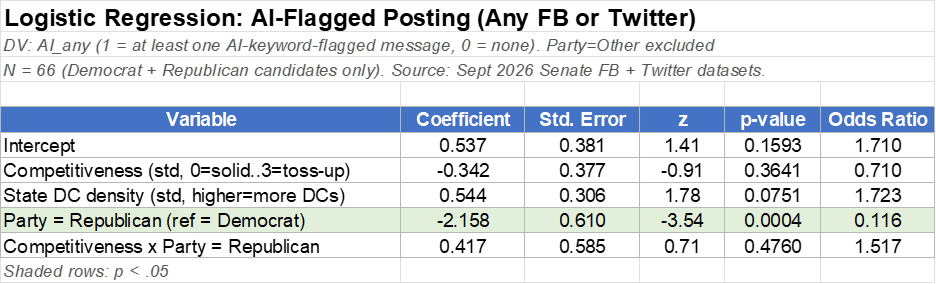
Republican candidates have about 88% lower odds of posting at all about AI or data centers than Democrats, holding competitiveness and data-center density constant (p = .0004). Each one-point increase in standardized state data-center density is associated with about 72% higher odds of posting — a meaningful-looking effect, but one that falls just short of conventional statistical significance (p = .075). Race competitiveness itself shows no effect.
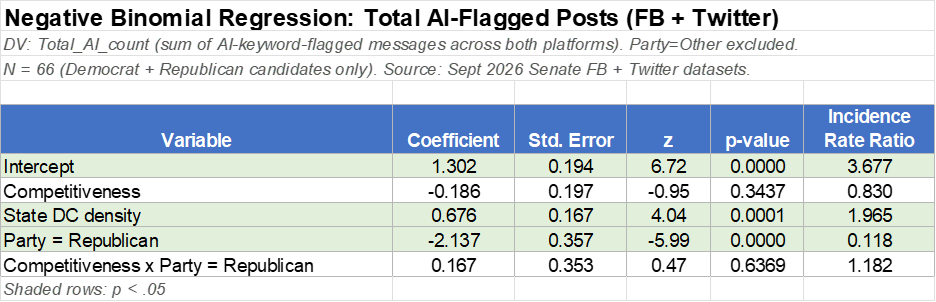
Among all the posting candidates do, Republicans post roughly 88% fewer AI/data-center messages than Democrats (p < .0001), and each one-point increase in standardized data-center density is associated with roughly double the volume of AI/data-center posts (p = .0001). Competitiveness does not predict posting volume either.
This analysis is part of the larger Illuminating Project lab. Special thanks to Sarah Hoover, doctoral student, and Avery Allen, undergraduate student, in the School of Information Studies.