
Data centers: The new industrialization in need of thoughtful regulation
New York's data center moratorium reveals as much about what's missing as what it addresses.

New York is the first state in the nation to establish a moratorium on data center construction. Governor Kathy Hochul signed the executive order June 14 pausing “hyperscale” data center construction in the state—data centers that use 50 megawatts or more to operate (the equivalent of roughly 40,000 homes).[i] Recent reports suggest at least 28 new datacenters have been proposed, many of which would consume 20 or more megawatts. If all were approved, they would increase electricity demand in the state by at least one-third, at a time when the state’s electricity grid is aging and at capacity.
The response by New York speaks to the growing resistance from the public to the new AI industrialization boom. Data centers themselves are not new, and their growth is essential to powering the revolution we’ve seen in AI capabilities. The economic power of AI is an important driver of current economic growth in the US. But the current shift in public mood is due to a set of factors, including increased electricity costs, worry about water usage and increases in greenhouse gas pollution, and an overall public malaise around AI.
In New York, the number of data center project requests has skyrocketed from just six in 2022 to over three dozen in 2026, according to the New York State Independent System Operator, which manages the state’s electric grid. New York is on the low end of data center operations, with approximately 134 data centers in the state. New York's access to water, electricity, and undeveloped land and old industrial sites make this region attractive.
Figure 1: Existing New York State Data Centers
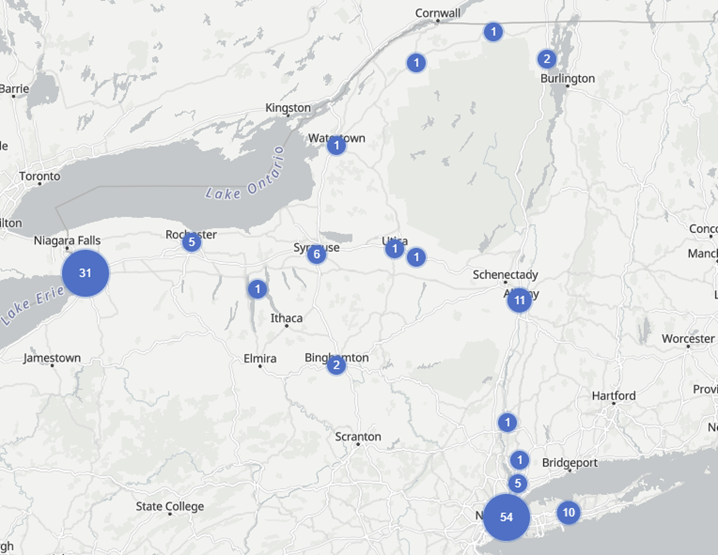
Source: Data Center Map
The national data center build-out amounts to the most expensive and intensive new industrialization ever, and it has local, national, and global implications. While data centers are integral to AI, and AI to the economy, the people who find themselves grappling with living with a data center have been overlooked and ignored. Because data centers have immediate effects not just on local communities, but also on regions and the nation, more comprehensive policy is desperately needed in this new age of industrialization. Since the federal government has been unable to meaningfully address the public’s concerns, the states will need to take the lead.
What is a Data Center and Why are They a Concern?
The public does not love data centers. They have legitimate concerns about the environment, increased electricity costs, noise pollution, and with those concerns have come increased public protests over data centers. Before explaining the environmental concerns, it’s useful to take a step back to understand how data centers work, why they need electricity and water, and their estimated economic impact on municipalities.
Data centers are the actual brains of the AI models that we use. When you type a query in Google and get an AI-generated response, the query, called an inference, is processed in a data center. Data centers are also where the so-called “frontier” models are developed. These are the massive models that underpin the AI we use when we ask it questions or give it tasks. Data centers also run the agents that people program to do tasks for them, including write code, sort email, or monitor the Web for information. In other words, when we prompt, we are asking the frontier model to infer a response, essentially to make a prediction, based on the trained model.
Data centers require massive amounts of electricity to run because the computer chips that do the complex, repetitive mathematical calculations to either build a frontier model or generate answers from it require large amounts of electricity. The most common chip that is used is Nvidia’s graphics processing unit (GPUs). These chips were initially developed to support the calculations to render images and videos on computers and were essential for creating immersive video game environments. In 2012, researchers discovered that GPUs could also do the complex parallel matrix math required for image recognition and computer vision.
The electricity that drives GPUs usually comes from the existing electricity grid. Our electricity grid is powered by a mix of coal, natural gas, nuclear, and alternative energies, like wind and solar, but the largest energy generators by far are from coal and natural gas. The International Energy Agency in 2020 estimated the likely power sources that would fuel AI in the future. Their forecasts estimated that natural gas would be the largest source of energy to power electric generators for the grid with nuclear and renewables making up a sizeable minority. Their estimates then did not predict the Trump administration’s hard shift away from renewables and back to fossil fuels, thereby increasing reliance on the environmental pollutants that drive climate change.
Figure 2: International Energy Agency Forecast of Fuel Sources to Power AI
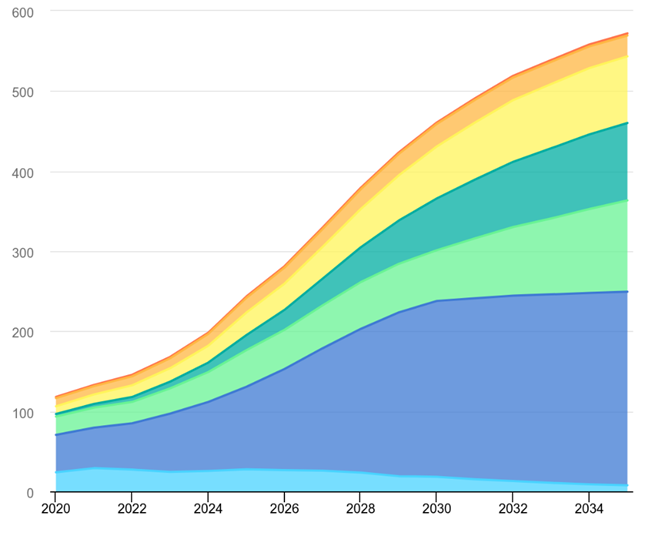
Source: IEA.org
The current grid is now a bottleneck for the multitude of datacenter projects around the country, as there simply is not enough excess energy in the current power generators to support the demands from data centers. Some data center companies have thus turned to dedicated or on-site power generation. These “behind-the-meter” approaches include restarting the infamous Three Mile Island nuclear powerplant in Pennsylvania after it was closed in 2019 for economic reasons. Microsoft is purchasing the power in a 20 year lease. In New York, Greenidge, a publicly-traded company, purchased a coal-fired plant in Torrey, NY in Yates County to power their own crypto-mining and data center operations. It has raised concerns about increased air pollution in the nearby Finger Lake communities and harming Seneca Lake.
Electricity costs are perhaps one of the most tangible consequences of data centers. Nearby communities end up paying higher energy costs, in part because the electricity grid operators pass the costs of adding new high-powered lines and upgrades to handle increased electricity demand to residents. A recent electricity auction suggests that an additional $6.3 billion will be added to bills of households and businesses. This in turn risks increasing inflation, which is already a concern.
Because the chips require so much electricity to perform their calculations, they generate heat. In order to prevent the chip from slowing down, called “throttling,” they require cooling. Most large-scale data centers rely on water-based cooling systems that use evaporation to exchange heat, although newer data centers are shifting to closed-loop water or air-based systems.[ii] An analysis by Bloomberg identified that many of the proposed and in-development data center projects are in water-stressed regions, including Arizona, southern California, Colorado, Utah, and Georgia. Communities in Georgia have reported undrinkable well water from Meta data center construction projects.
Figure 3: Bloomberg analysis of data center build-outs in water stressed regions
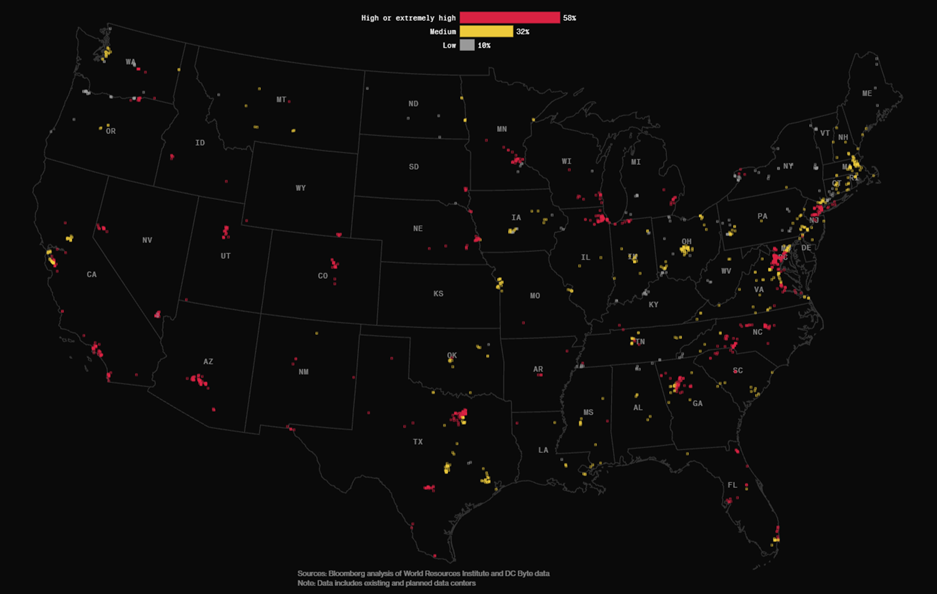
Source: Bloomberg
Then, there’s the size. While data centers range in size and capacity, more recent facilities tend to be substantially larger than older data centers. Some of the largest campuses today will consume gigawatts (over 1,000 megawatts). Their physical footprints also are expanding. A proposed facility in Louisiana to support Meta’s AI would be 4 million square feet across 11 buildings on roughly 3,600 acres, about half the size of Manhattan. The reason for the massive footprints is due not only to the increased number of processors but also the necessity for the cooling and power infrastructures; these require significant space. Moreover, data center operations require redundancies in cooling, electricity, and compute to reduce risks of outages.
Another concern is their placement and that of the power plants needed to generate electricity. Historically marginalized communities often bear the brunt of the negative environmental impacts from data centers. Perhaps one of the more infamous cases is from xAI’s build-out of a data center in Memphis, TN that relied on methane-burning generators (producing enough electricity to power 255,000 homes) that spew high levels of air pollution into a poor and predominantly Black community. The data center relies on generators because Memphis’ electric grid cannot handle the demand. The company was able to get waivers from the city to operate the generators. But xAI found a loophole that has allowed it to continue running the highly polluting generators than the waiver allowed.
In addition to air pollution, data centers are not silent operations. They also produce noise pollution. Residents in northern Virginia complain about the noise from data centers, including high-pitched whines and loud humming that exceeds 90 decibels. Because each GPU requires fans for cooling, the constant hum from the fans can be heard or felt by nearby residents. Onsite generators when in operation contribute further to loud noise.
The Economic Upsides of Data Centers
Northern Virginia is a useful test case for understanding the benefits of data centers in the US. Virginia has been a home to data centers over the past three decades, capitalizing on existing high power electricity lines, abundant water, undeveloped land, and tax incentives to bring in technology companies, including Yahoo! in the early days of the World Wide Web, to Amazon as cloud computing and cloud storage grew, and now data centers to power AI. There are an estimated 600 data centers in the region, and a recent government report cited the economic benefits to include over 74,000 jobs and $9 billion in the economy per year. In Loudoun County, where a majority of the data centers are located, almost half of all property tax revenue is from data centers, bringing in more than $100 million annually.
Data centers also are proposed for former industrial sites. In New York, the closed Remington Arms factory in Ilion is being considered for a data center project, that if approved could use as much as 250 megawatts of electricity making it one of the larger proposed data centers in the state. Terawulf converted a former coal-power plant site first into cryptomining and now into AI data centers in a multi-site campus in Buffalo that is approved for as much as 500 megawatts of electricity at a time, and a proposed 400 megawatt facility at a former coal-fired power site on Cayuga Lake. These projects bring back onto the property tax rolls defunct properties. The modernization and clean-up improves property values for nearby businesses and communities.
The economic benefits extend more broadly. These include increased economic opportunities as related businesses open and operate. Data centers, like other examples of industrial economies, draw adjacent industries as well as other infrastructure, from gas stations to restaurants. Some research suggests, though, that those positive economic benefits are more likely in metropolitan than in rural areas.
New York’s Moratorium: What it Means and What it Lacks
The moratorium that Governor Hochul signed was an executive action. What she chose not to do was sign a bill passed by the State Legislature earlier this year that also would have established a moratorium but on smaller projects of 20 megawatts or more. In an interview, Hochul explained that she initially felt that data center permitting should remain a local issue, but as an increasing number of local leaders reached out asking the state for guidance, she decided that the state needed to step in and create some minimum guidance.
Hochul’s moratorium calls for the Department of Public Service (DPS), a state agency that oversees utilities including gas, electric, and water in the state, to develop a Generic Environmental Impact Statement (GEIS) that data centers would need to meet. The GEIS would assess the water, electricity, air quality, and impacts on marginalized communities of data centers, and establish standards that data centers would need to meet. The DPS will also develop a community investment framework to help local governments in their assessments of data center projects, extending not just to the environmental and economic issues, but to other dimensions, such as wage standards, apprenticeships, and investments to improve the community. Hochul directed DPS to consider establishing an electricity grid fund that would require data center operators to contribute, and would encourage legislation to repeal a state sales-tax exemption that some data center operators in the state had been claiming. Finally, the moratorium tasked the Department of Environmental Conservation to review existing policy and processes regarding water usage to ensure it pertains appropriately to data centers.
New York’s move to pause data centers comes at a time when other states are considering their own moratoriums. Maine’s legislature passed a moratorium on data center construction that was vetoed by their governor. The Seminole Nation passed a moratorium banning data center development on their lands in Oklahoma. It runs counter, though, to the prevailing pressure for economic growth. California’s and Michigan’s governors have praised data centers as bringing new economic opportunities to their states. President Trump attacked New York's moratorium on Truth Social, calling data centers “liquid gold”.
The moratorium would pause some of the larger projects being proposed in the state. The moratorium explicitly pauses projects that require new state environmental approvals that are 50 megawatts or more. The Remington Arms data center proposal, which has not begun the environmental review process, is on hold—although the brownfields cleanup required for any development of the site can continue. The Terawulf project proposed on Cayuga Lake is also on hold, although their Buffalo build-out of their 500 megawatt facility can continue, as their environmental review is complete.
States have stepped up their involvement in regulating data centers and AI, as the Trump administration continues its push for generally unfettering AI growth. President Trump in his first days in office signed an executive order that wiped out Biden-era guidelines that encouraged privacy protections among other things on AI companies. Trump’s order called for a reduction in environment oversight of data center construction to speed up the industry, and he called for a ban on federal government contracts with AI that was designed with what he characterized as ideological bias. More recently, though, as the public broadly has soured on data centers, Trump urged AI companies to pay for the costs of the needed energy for data centers.
The new AI industrialization requires more than assessments of environmental and community impacts—while those are important. Missing in discussions about data centers and their build outs are ongoing challenges around transparency. First, there are no tracking or reporting mechanisms for data centers, nor how many there are how much electricity they use. Different organizations purport to track data centers (see Data Center Map and Cleanview for examples) and their estimated electricity usage around the US, but their numbers generally do not agree. In order for any state to estimate electricity usage of data centers, now and in the future, getting reliable existing data is essential.[iii]
Second, many of the data center projects that are now in the building stage were approved with little public input or even meaningful public notice. In San Antonio, for example, residents learned that two natural gas power generators are being built in their communities to supply power to data centers. The data centers got approval to build the power plants after securing a permit as a source for minor air pollution, the type of permit typically granted to gas stations or dry cleaners. A data center in Abilene, similarly blind sided residents when construction began. The city granted the permit to build with no public input. The bill the New York State Legislature passed would have required at least one public, in-person meeting, to promote greater awareness and transparency.
Third, one problem that plagues data center permitting processes is the requirement that elected officials sign non-disclosure agreements (NDAs),[iv]. When public office holders and their staff sign NDAs, it restricts them from sharing essential details with the public and journalists about the projects and their implications. Moreover, data center companies often refuse to make information public, including estimated water and electricity usage, under the guise of trade secrets.
Fourth, many of the companies that build out data centers are shells that hide their true ownership. Local governments end up negotiating and permitting to companies whose origins are obfuscated. This raises risks for local governments. If the data center harms the water system or pollutes the environment, the shell company can dissolve leaving the municipality unable to sue any responsible party. Shell companies can also shift ownership to dodge taxes or assessments. Hidden ownership means that local officials or family members can secretly profit, bypassing common ethics rules.
NDAs, trade secrets, and shell companies further challenge data center projects. Citizens like to know who is doing business in their communities and what the consequences will be, and the lack of transparency further harms that trust. In an age where the public already severely distrusts government and institutions, the current way of doing business by data center owners only further fuels skepticism.
Conclusions
Meaningful regulation in the new AI industrial age will need to consider not only the environmental and social costs of AI, but also tackle the need for greater transparency around data centers and associated AI companies. With the federal government unable to address the public’s growing concerns about data centers, as more and more of them are proposed around the country, the states are ultimately left to lead.
[i] Calculating electricity consumption is tricky, as energy demand fluctuates depending on factors including the external environment, insulation, and number of appliances. More energy is drawn in the summer from electricity-powered cooling, so in peak demand, 50mw would power less than 20,000 homes. The 40,000 homes estimate is an average across a year.
[ii] The challenge is that closed-loop and air-cooled systems require more electricity than water-evaporation systems.
[iii] Accurate forecasting relies on accurate base data. Even small inaccuracies can lead to wildly inaccurate forecasts.
[iv] In Virginia, 80% of data center permits were done with elected officials signing NDAs.